
More than half of 2025’s 269 small-company debuts now trade below issue price, data show
The BSE SME IPO Index has tumbled to 91,627, down 23% from its July 2025 peak, as India’s small-company listing boom collides with the reality that most investors end up underwater. And in the past year the S&P BSE SME Index is down 16.5% to 85501.
Data compiled from all 269 SME IPOs that listed in 2025 reveal the scale of investor pain. While 170 companies posted gains on their debut with an average listing-day pop of 12.2%, only 112 now trade above their issue prices. That leaves 156 IPOs — 58% of the total — underwater, with a median loss of 7.1% from issue price.
The reversal marks a dramatic shift for a segment that delivered triple-digit returns in 2024 and became the 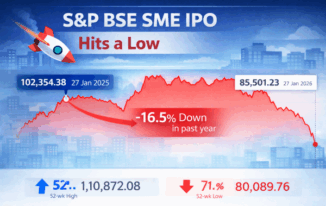 most active corner of India’s capital markets. The average return has deteriorated from a 12.2% listing-day gain to just 6.2% currently, a six percentage-point erosion that represents billions in paper losses.
When the Music Stopped
Rikhav Securities epitomizes the reversal. The company listed in January 2025 with a 99.5% surge that sent its shares to Rs 171.55 from an issue price of Rs 86. Today the stock trades at Rs 44.83, a 48% loss fro m issue and a 147 percentage-point swing from its listing-day high.
Kabra Jewels followed an identical trajectory — up 99.5% on debut from its Rs 128 issue price, now down 29% to Rs 91.25. Srigee DLM soared 99.5% on listing day before falling to a 27% loss from issue. Luxury Time jumped 99.5% in early trading, only to reverse into a 7% decline.
The pattern extends across dozens of companies. Smarten Power Systems rallied 51% on its first day from a Rs 100 issue price before sliding to Rs 64.65, a 35% loss. Manas Polymers & Energies rocketed 80% higher on debut,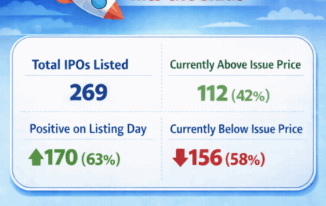 then surrendered nearly all those gains to trade 10% below issue.
The Arithmetic of Allocation
The mechanics of SME IPOs create a system where listing-day winners rarely translate to broad investor gains. Small issue sizes and large minimum lot requirements — often 1,200 shares or more — mean allocation rates hover around 2% for popular offerings.
The 98% who fail to secure shares often pile into secondary trading at inflated prices, buying the listing-day momentum that proves fleeting. Of the 170 companies that debuted with gains in 2025, 58 have since turned negative — a conversion rate of one in three from winner to loser.
Outliers and the Median Truth
Spectacular performers do exist in the data. Anondita Medicare has returned 570% from its issue price of Rs 64. Tankup Engineers delivered a 351% gain from Rs 140. Cryogenic OGS climbed 260% from Rs 47. Sacheerome returned 259% from Rs 102.
These names fuel grey market speculation and keep retail application forms flowing. But they represent the extreme right tail of a distribution heavily skewed toward losses.
Valencia India has fallen 82% from its Rs 110 issue price to Rs 19.56. Studio LSD dropped 81% from Rs 152. Aten Papers & Foam declined 77% from Rs 96. Citichem India lost 76% from Rs 70. Logiciel Solutions fell 75% from Rs 193.
The median return of negative 7.1% means half of all 2025 SME IPOs have lost investors more than that amount. The average return of 6.2% — dragged higher by the extreme winners — masks the fact that most participants lose money.
December’s Cautionary Tales
The final month of 2025 offered a microcosm of the broader dynamic. Of 13 SME IPOs that listed in the last two weeks of December, eight trade below their issue prices.
Sundrex Oil listed on December 30 with a 24% loss from its Rs 86 issue price and now trades at Rs 31.60, down 63% from issue. Neptune Logitek opened 24% below its Rs 126 issue price on December 22 and has since plunged to Rs 52.23, a 59% loss. Riddhi Display Equipments listed 24% lower from Rs 100 and now trades at Rs 40.12, down 60% from issue.
What Investors Face
The data permit few illusions about odds. Of 269 SME IPOs in 2025, 156 trade below issue price. The median investor has lost 7.1%. Of those who secured listing-day gains, one in three has since turned negative.
For the 42% who picked winners or sold into listing-day strength, returns have been strong. The top decile of performers delivered 176% to 570% gains. But for the median participant, the SME IPO market has destroyed rather than created wealth.
The BSE SME IPO Index downslide signals that the easy-money phase has ended. Whether the index finds support at current levels depends on whether new listings can generate enough momentum to overcome the gravitational pull of deteriorating fundamentals in existing holdings.
So far, the math hasn’t worked.