
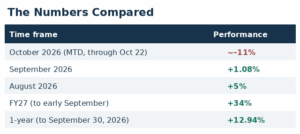
On September 30, 2026, the Nifty IPO Index closed the month 1.08% higher. Three weeks into October, that index is down approximately 11% from its September 30 close, giving back a meaningful chunk of the gains it had held through FY27.
For most of FY27, the Nifty IPO Index — which tracks companies listed on the NSE for up to two years after their debut — was the quiet outperformer of Indian equities. As of early September, the index had rallied over 34% in FY27, driven by a surge in primary market activity after a slow first half of calendar 2026.
The flow of fresh paper into the market was unprecedented. The first six months of 2026 saw only 28 mainboard IPOs raise around ₹20,000 crore. July and August then flipped the pace entirely, with mainboard fundraising crossing ₹45,000 crore across the two months. August alone saw nearly 18 listings. September saw close to 30 mainboard debuts, including the long-awaited National Stock Exchange IPO itself.
Steady September
September 2026 was a difficult month for Indian equities almost everywhere. The Nifty 50 closed the month at 22,620.45, down 6.06% — its worst performance since March. The Nifty IT index crashed 11.18%. The Nifty Auto index fell 8.83%. Even the defensive sectors offered little shelter — Nifty FMCG was down 3.30% and Nifty Pharma down 2.75%.
Through all of this, the Nifty IPO Index closed September up 1.08%. It was the only index among the 19 sectoral and thematic baskets tracked by the NSE to finish the month in positive territory. The index was 35.78% above its yearly closing low and sat just 2.35% below its yearly closing high — statistics almost no other Indian index could match.
But October Reversed
October has reversed that outperformance in roughly three weeks. The Nifty IPO Index is now down approximately 11% from its September 30 reference level, giving back a meaningful portion of the gains it had held through the third quarter and taking the index back to levels last seen in late July.
The specific trigger set is a combination of factors that have converged on exactly the kind of names the index holds — recently listed, often small-to-mid-cap, often from thematic sectors like defence, specialty chemicals, consumer tech and new-age financial services.
The Reserve Bank of India delivered a 25 basis point repo rate hike on October 7, taking the policy rate to 5.50% and shifting its stance from neutral to calibrated tightening on a 4:2 vote. Recently listed stocks typically trade at valuation multiples well above the broader market — making them disproportionately exposed to rising discount rates.
Foreign portfolio investor outflows have continued through October, extending the ₹2.42 lakh crore of FII selling already recorded in calendar 2026. US Treasury yields have remained elevated around the 5.2% zone, keeping emerging market risk-reward unattractive at the margin.
A Supply Problem
The structural factor behind the October correction is the sheer weight of paper that hit the market across July, August and September. Close to 30 mainboard debuts in September alone created a flood of new free-float that institutional and retail buyers had to absorb.
The Nifty IPO Index itself has expanded through the period. The index now holds around 149 stocks against roughly 103 earlier in the year, as the methodology adds each new listing after 30 days of trading. On October 9, the NSE Index Maintenance Sub-Committee announced the inclusion of Vishal Nirmiti and Nityas Gems and Jewellery, effective from October 14. More inclusions are expected over the coming weeks as September debutants cross their 30-day threshold.
Each new addition further dilutes the weight of the earlier outperformers that drove the FY27 rally — names like Dhoot Transmission, Xtranet Technologies, Milky Mist Dairy Food and ESDS Software Solution — and brings in fresh names that have themselves listed into a weaker secondary market.
What Changes From Here
The question for retail investors tracking the IPO basket is whether the October drawdown is a cyclical shakeout or the beginning of a longer de-rating of the recently listed cohort.
Historical evidence from similar supply-driven corrections has been mixed. Across one-year holding windows since 2017, the Nifty IPO Index has returned a median of +5.52%, with a best window of +96.36% and a worst of -29.37% — the widest dispersion among major NSE indices.
The two near-term variables to track are the pace of fresh issuance through November and December (which determines how much more paper the market has to absorb) and whether the RBI’s December meeting delivers the further 25 basis point hike that Goldman Sachs and other forecasters expect. Both will shape how the recently listed cohort trades through the rest of FY27.
For now, the IPO market remains hot though with plenty of issues still lined up. But if the market trend continues to be soft and post listing gains dwindle, it would impact new issues.
