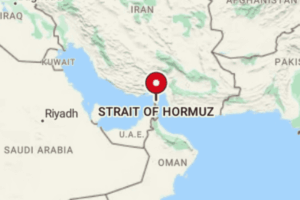


From $65 to $71 in days, India’s crude basket is flashing early warning signs. The real question now is how long the Strait of Hormuz stays safe.
For India, oil is crucial and has enormous impact on the macro stability, inflation math, fiscal arithmetic and, yes, market mood.
In a matter of days, the Indian crude basket has climbed from roughly $65 a barrel to around $71, as geopolitical tremors in West Asia force traders to reprice risk. The coordinated U.S.–Israel strikes on Iran and Tehran’s retaliation across the Gulf has shifted oil into the headlines that warn of dangers ahead for the Indian economy and markets.
Pricing the Strait
Iran today produces about 3.3 million barrels per day, roughly 3% of global supply. On pure production metrics, that looks manageable. But geography tells a different story. Iran sits astride the Strait of Hormuz — the narrow artery through which nearly 20% of global oil and a similar share of LNG flows.
Analysts put the arithmetic bluntly. A one-week closure of Hormuz could mean a $10 per barrel impact — roughly what markets appear to be pricing. Stretch that disruption beyond two weeks, and crude could rise by as much as $45 per barrel.
History shows oil markets rarely wait for actual supply losses. In the 1973 Arab embargo, prices surged nearly 300%. During the 1990 Gulf War, crude doubled before retreating as Saudi output stabilised supply. In 2022, when Russia invaded Ukraine, Brent spiked above $120 before trade flows rerouted and prices normalised within six months.
As Equirus notes in its latest assessment, “oil overreacts first, embeds a geopolitical risk premium, and then gradually adjusts as trade flows reroute and fundamentals reassert themselves.” But the real forecasting challenge is estimating how long this persists.
Impact on India
India imports more than 85% of its crude needs. Every $10 rise in oil adds roughly 30–35 basis points to headline inflation and widens the current account deficit.
Higher crude filters through multiple channels. LPG prices matter politically. LNG flows — 20% of which transit Hormuz — affect power and fertiliser costs. Freight and insurance premiums rise when tankers are targeted, even if physical barrels keep moving. Three vessels have already reportedly been hit in the region, pushing up risk cover.
For now, markets are reassured that energy infrastructure remains largely untouched. There have been no strikes on Iran’s Kharg Island terminal, nor major Saudi export hubs like Ras Tanura. A direct hit on refining or export capacity would move oil “quickly and structurally higher,” in Macquarie’s words.
“If Iran’s 3% supply were fully disrupted, and assuming a 3–5% price response per 1% supply shock, crude could mechanically rise 9–15%. On a $70 base, that implies $76–$81 per barrel. But if Hormuz risk becomes structural, the premium could widen by $20–$40, reopening a path toward $95–$110,” said Equirus in a client note.
Oil Price Scenario Matrix
| Scenario | Assumption | Price Impact Logic | Brent Target Range |
|---|---|---|---|
| Baseline | No material disruption; fundamentals dominate | OPEC+ supply rising; inventories adequate | $60–$70/bbl |
| Iran Supply Disruption (~3% of global supply) | ~3.3 mbpd disrupted | 3–5% oil price move per 1% supply shock → 9–15% rise | $76–$81/bbl (from $70 base) |
| Escalation Risk to Strait of Hormuz | Structural geopolitical premium embedded | $20–$40/bbl premium possible beyond mechanical impact | $95–$110+/bbl |
Source: Equirus Securities – Geopolitical Oil Risk Assessment
Interestingly, Asia appears calmer than Europe. Inventories are relatively comfortable, winter demand has passed, and alternative supplies — including Russian barrels and rising OPEC+ output — provide some cushion. China, for instance, is believed to hold substantial above- and underground inventories, potentially covering months of imports.
India has also diversified supply since 2022, absorbing discounted Russian crude when Western buyers stepped back. That has helped mitigate the impact of the last oil price rise.
Huge Risk Premium
If strikes extend to core energy infrastructure — pipelines, export terminals, refineries — repairs become complex and timelines stretch.
For India, the calculations are clear. As long as Brent stays below $80–$85, the macro system can absorb the shock. Beyond that, fiscal math begins to sour, which will be difficult to manage.
Oil’s history is clear. It spikes violently in crises, then cools as trade routes adapt. The question for India is whether this proves another temporary overreaction, or whether the oil premium sustains for longer periods.
For now, $71 is manageable, but expect it stay on the upper side for now.