

The US-Israel strike that killed Khamenei has changed the geopolitical reality in the Middle East. Indian markets will pay the price on Monday, the question is for how long.
The weekend did not bring rest. It brought fire over Tehran, the death of a supreme leader who had ruled Iran for 37 years, and a financial world scrambling to price in the unthinkable. The United States and Israel launched coordinated strikes on Iran on Saturday, killing Ayatollah Ali Khamenei and decimating the country’s senior military and security leadership in what Washington called Operation Epic Fury. Iran retaliated with missile and drone attacks on US bases across the Middle East. By Sunday morning, Gulf airspace was partially closed, major trading houses had suspended Hormuz shipments, and every risk desk on the planet was running the same scenario: what does this mean when markets open on Monday?
Brent crude closed at $72.87 on Friday, a seven-month high has started to price in the fear. Monday’s open is going to be a different animal entirely.
The Hormuz Question Is Everything
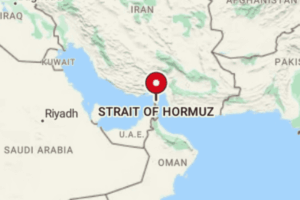
Start where every commodity desk on earth started Saturday morning: the Strait of Hormuz. Through that narrow passage, roughly 20% of global oil flows daily — and critically, over 40% of India’s crude imports transit this single chokepoint. Iran has long threatened to shut it down in extremis. This is extremis. Major trading houses have already suspended shipments. The strait is still flowing — for now.
In a note published Sunday, JM Financial called the Strait of Hormuz the decisive variable, warning that “the probability and duration of supply interruption” is now the key question for markets. The scenario analysis from the brokerage is sobering reading.
| Scenario | Oil Price Impact |
|---|---|
| Limited retaliation | +$5–10/bbl |
| Iran oil infrastructure hit | +$10–12/bbl |
| Hormuz disruption | Above $90/bbl |
| Broader regional war | Above $100/bbl |
Source: JM Financial
For India, the arithmetic is going to be hard. Every $1 rise in crude increases the annual import bill by approximately $2 billion, JM Financial noted, putting immediate pressure on the trade balance, the rupee, and ultimately inflation. “The transmission channel is clear,” the report said — higher crude feeds inflation, higher inflation pushes bond yields up, rising yields compress equity multiples. Indian markets, JM Financial warned, are likely to move from earnings-driven to oil-driven trading in the near term.
Nifty Is Sending a Signal
The Nifty 50 ended Friday already bruised at 25,178, down 1.25%. The psychological 25,000 level will be tested quickly. But here is what experience suggests: panic opens frequently overdiscount. A gap-down of 300–400 points — taking Nifty toward the 24,800–24,900 zone — is entirely plausible at the bell. That kind of sharp move, however, tends to attract value buyers, short-covering, and institutional stabilisation. A partial bounce back toward 25,100–25,200 by the close is realistic if there are no fresh escalatory shocks through the session. Markets have done this before. The question is what comes after.
Gold Has Spoken
Gold was already up 22% in 2026, trading above $5,000 an ounce. Monday’s open will gap higher still. Safe-haven flows are converging into gold, silver, and US Treasuries simultaneously. In a market otherwise painted red, gold is likely to be the one sector lit green on the screen.
What Breaks, and What Doesn’t
JM Financial mapped the sectoral damage plainly. Oil marketing companies, paints, tyres, aviation, and chemicals all face meaningful margin pressure from higher input costs. On the other side of the ledger, upstream oil producers benefit from stronger realisations, and defence names are likely to see sentiment support — what the report called “primarily sentiment-driven” — in a world that is visibly, rapidly rearming. Currency-sensitive exporters may find partial shelter in a weaker rupee. Thin comfort — but on a Monday like this, thin comfort is what you work with.
The Longer Game
Step back from the screen and consider the world that opened this week. Iran’s supreme leader is dead, along with senior Revolutionary Guard and national security officials. JM Financial described the strikes as “the most direct confrontation” between the US-Israel alliance and Iran since June 2025, noting that the prior conflict resulted in over a thousand fatalities, a measure of the scale such escalation can reach. Iran has already retaliated with missile and drone strikes on US bases across the Middle East. Washington says the strikes will continue until peace is secured.
The containment scenario exists: a rapid Iranian transition, a negotiated halt, crude capped near $80, markets recovering much of Monday’s losses and some in a week or so. Indian equities have shown remarkable resilience through shocks before.
However, the real verdict will be delivered over the following weeks if one question is answered: is this a swift decapitation strike that ends with a negotiated Iranian transition — or the opening chapter of a protracted Gulf war that structurally reprices oil, inflation, and risk across every emerging market on earth?
If it is the former, Monday’s low could be viewed as an opportunity. If it is the latter, the 52-week high on the Nifty will be like a huge mountain to climb.